
New Year Sale 2026! Hurry Up, Grab the Special Discount - Save 25% - Ends In 00:00:00 Coupon code: SAVE25
Welcome to Pass4Success

- Free Preparation Discussions

Splunk SPLK-1002 Exam - Topic 8 Question 83 Discussion

Actual exam question for Splunk's SPLK-1002 exam
Question #: 83
Topic #: 8
[All SPLK-1002 Questions]

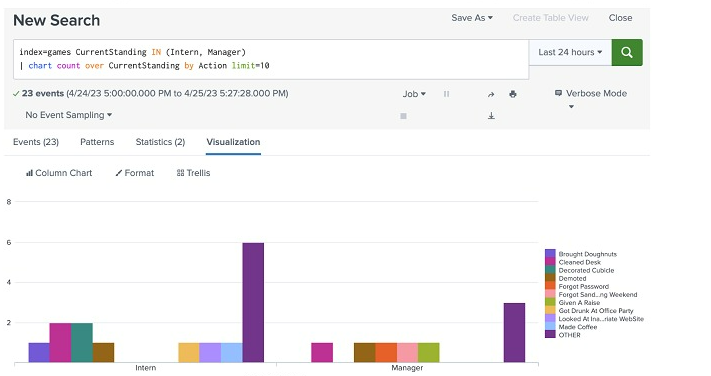
How could the following syntax for the chart command be rewritten to remove the OTHER category? (select all that apply)
Show Suggested Answer Hide Answer
Suggested Answer: A, C

In Splunk, when using the chart command, the useother parameter can be set to false (f) to remove the 'OTHER' category, which is a bucket that Splunk uses to aggregate low-cardinality groups into a single group to simplify visualization. Here's how the options break down:

A) | chart count over CurrentStanding by Action useother=f This command correctly sets the useother parameter to false, which would prevent the 'OTHER' category from being displayed in the resulting visualization.

B) | chart count over CurrentStanding by Action usenull=f useother=t This command has useother set to true (t), which means the 'OTHER' category would still be included, so this is not a correct option.

C) | chart count over CurrentStanding by Action limit=10 useother=f Similar to option A, this command also sets useother to false, additionally imposing a limit to the top 10 results, which is a way to control the granularity of the chart but also to remove the 'OTHER' category.

D) | chart count over CurrentStanding by Action limit-10 This command has a syntax error (limit-10 should be limit=10) and does not include the useother=f clause. Therefore, it would not remove the 'OTHER' category, making it incorrect.

The correct answers to rewrite the syntax to remove the 'OTHER' category are options A and C, which explicitly set useother=f.


Contribute your Thoughts:

0/2000 characters
Jaclyn
3 months ago
I agree with A and C, those make sense!
upvoted 0 times
...
Carin
4 months ago
D? Really? That doesn't seem right.
upvoted 0 times
...
Rebbecca
4 months ago
C is definitely a valid option!
upvoted 0 times
...
Clorinda
4 months ago
I think B works too, but not sure about the syntax.
upvoted 0 times
...
Kendra
4 months ago
A is correct, it removes OTHER.
upvoted 0 times
...
Fausto
4 months ago
Option D seems like a good choice too since it just limits the results without mentioning OTHER at all.
upvoted 0 times
...
Ty
5 months ago
I’m a bit confused about option B; I thought usenull-f would keep null values but not sure how it relates to removing OTHER.
upvoted 0 times
...
Dona
5 months ago
I remember a practice question where we had to limit categories, and I feel like option C is similar because it uses limit=10.
upvoted 0 times
...
Myra
5 months ago
I think option A might be correct since it explicitly sets useother to false, but I'm not entirely sure.
upvoted 0 times
...
Kimi
5 months ago
I'm still a bit unsure about the difference between "usenull-f useother-t" and "limit=10 useother=f". Both seem to be trying to remove the "OTHER" category, but the wording is a bit different. I'll need to do some more research on the specific parameters to be sure I understand the nuances.
upvoted 0 times
...
Rashad
5 months ago
Okay, I think I've got it. The first option, "useother=f", looks like the way to go. That should remove the "OTHER" category entirely from the chart. The other options seem to be trying to limit the results in different ways, but they don't directly address the "OTHER" category.
upvoted 0 times
...
Gilma
5 months ago
This looks like a straightforward question about the chart command in Splunk. I think the key is to focus on the "useother" parameter and how to remove the "OTHER" category from the chart.
upvoted 0 times
...
Krystal
5 months ago
I'm a bit confused by the different options here. It seems like some of them are trying to remove the "OTHER" category, while others are just limiting the number of results. I'll need to carefully read through each option to understand the differences.
upvoted 0 times
...
Wilburn
5 months ago
Wait, is plate type and license plate the same thing? I'm a bit confused on the difference between those two options. I'll need to double-check that before submitting my answer.
upvoted 0 times
...
Glenn
5 months ago
This looks straightforward. Based on my knowledge, the two encryption types supported are X.509 and 3DES. I'll select those.
upvoted 0 times
...
Lashon
5 months ago
This seems like a pretty straightforward question. I'd focus on the key requirements - high transaction volume during peak hours and constant user access. That points me towards looking at the transaction characteristics and how to optimize the system performance.
upvoted 0 times
...
Osvaldo
2 years ago
Hmm, that's a good point. Maybe we should try both approaches in the exam to be safe.
upvoted 0 times
...
Darrin
2 years ago
I'm not sure about the correct answer, but I think both A and B could potentially work to remove the OTHER category.
upvoted 0 times
...
Nichelle
2 years ago
I disagree, I believe the correct answer is B. We should use usenull-f and useother-t to remove the OTHER category.
upvoted 0 times
...
Osvaldo
2 years ago
I think the answer is A. We should use useother=f to remove the OTHER category.
upvoted 0 times
...
Tayna
2 years ago
I think option D is incorrect because it has a syntax error with limit-10 instead of limit=10.
upvoted 0 times
...
Tonette
2 years ago
I still think option B is the best because it explicitly mentions removing the OTHER category.
upvoted 0 times
...
Kassandra
2 years ago
I see your point, Option C does seem like a valid choice as well.
upvoted 0 times
...
Gerry
2 years ago
I'm not sure, but I think option C could also work with useother=f and limit=10.
upvoted 0 times
...
Tonette
2 years ago
I disagree, I believe option B is better because it has both useother-t and usenull-f to remove the OTHER category.
upvoted 0 times
...
Kassandra
2 years ago
I think option A is correct because it has useother=f to remove the OTHER category.
upvoted 0 times
...

Save Cancel