
New Year Sale 2026! Hurry Up, Grab the Special Discount - Save 25% - Ends In 00:00:00 Coupon code: SAVE25
Welcome to Pass4Success

- Free Preparation Discussions

Blue Prism ASDEV01 Exam - Topic 7 Question 13 Discussion

Actual exam question for Blue Prism's ASDEV01 exam
Question #: 13
Topic #: 7
[All ASDEV01 Questions]

Examine the following Blue Prism Process diagram:

The initial values of the data items are displayed in the diagram above All 3 data items are configured as Number

The 'Perform Calculation' stage Properties window is displayed below:
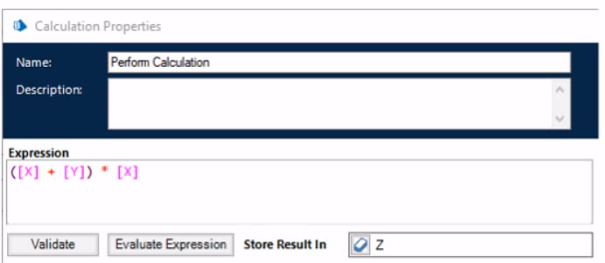
When this diagram is run through the the End stage, what will the current value of the Z data item be?

Show Suggested Answer Hide Answer
Suggested Answer: D

This is the correct value of the Z data item after running the diagram through the end stage. The calculation stage will set the value of Z to ([X] + [Y])* [X], which is (2 + 4) * 2 = 12. The other options are either incorrect or describe different scenarios. Reference: https://portal.blueprism.com/sites/default/files/2021-05/Blue%20Prism%20Certification%20-%20Associate%20Developer%20-%20Certification%20Overview_0.pdf (page 14)


Contribute your Thoughts:

0/2000 characters
Lenna
3 months ago
Wait, how do we know the initial values of X and Y?
upvoted 0 times
...
Domingo
3 months ago
I agree, A seems right, but what if X or Y is zero?
upvoted 0 times
...
Ria
4 months ago
I’m not so sure, could it really throw an exception?
upvoted 0 times
...
Glendora
4 months ago
I think it’s definitely option A!
upvoted 0 times
...
Lorean
4 months ago
The calculation is based on the values of X and Y.
upvoted 0 times
...
Rodolfo
4 months ago
I vaguely recall that if either X or Y is 0, the outcome could be 0 as well. I should probably go over the data item values again to be sure.
upvoted 0 times
...
Erasmo
5 months ago
I think the formula for Z is ([X] + [Y]) * [X]. If X is 2 and Y is 4, then Z should be 12, right? But I’m not completely confident about the initial values.
upvoted 0 times
...
Theodora
5 months ago
I'm a bit unsure about the calculation here. If X and Y are both set to 0, would that lead to an Internal Exception? I feel like I’ve seen that in a practice scenario.
upvoted 0 times
...
Serita
5 months ago
I remember that in similar practice questions, we had to evaluate expressions step by step. I think I need to double-check how the values of X and Y interact in this case.
upvoted 0 times
...
Rasheeda
5 months ago
Okay, let me break this down step-by-step. The initial values are given, and the formula is clear. I just need to make sure I'm plugging everything in correctly. I think I can figure this out, but I'll be sure to double-check my work.
upvoted 0 times
...
Hyun
5 months ago
Ugh, this is confusing. I'm not sure I fully understand how the "Perform Calculation" stage works. I might need to review that part of the material again before I can tackle this question.
upvoted 0 times
...
Jolanda
5 months ago
Alright, I think I've got this. The formula is straightforward, it's just a matter of plugging in the numbers correctly. Let me double-check my work, but I'm feeling pretty confident about this one.
upvoted 0 times
...
Blythe
5 months ago
Hmm, this looks tricky. I'm not totally sure how to approach it, but I'll give it my best shot. Maybe I can work through the formula and see if I can figure out the final value of Z.
upvoted 0 times
...
Chantell
5 months ago
Okay, let me think this through step-by-step. The initial values are X=2, Y=3, and Z=0. The formula in the "Perform Calculation" stage is ([X] + [Y]) * [X]. So I need to plug in those values and do the math.
upvoted 0 times
...
Keena
5 months ago
Alright, time to put my Azure knowledge to the test. I'm pretty confident phone call, text message, and Microsoft Authenticator app are the correct answers here.
upvoted 0 times
...
Patrick
5 months ago
Economies of scale could be a really important factor, especially for a large organization. If we can leverage existing infrastructure and resources, it could significantly improve the overall cost-effectiveness.
upvoted 0 times
...
Janine
5 months ago
Quantitative analysis is probably the safest bet, but I'm curious about the other options too. Maybe I'll quickly review my notes on each method before deciding.
upvoted 0 times
...
Marva
2 years ago
I see why you guys think that, but I still believe it's A) ([X] + [Y])* [X]
upvoted 0 times
...
Willow
2 years ago
I'm not sure, but I think the correct answer is E) 10
upvoted 0 times
...
Quentin
2 years ago
I'm leaning towards option C) 0 actually
upvoted 0 times
...
Deja
2 years ago
I disagree, I believe the answer is D) 12
upvoted 0 times
...
Marva
2 years ago
I think the answer is A) ([X] + [Y])* [X]
upvoted 0 times
...
Hailey
2 years ago
I believe the answer is D, 12, because based on the initial values provided in the diagram, it makes sense.
upvoted 0 times
...
Tresa
2 years ago
I don't think so, the diagram seems to be straightforward with no room for calculation errors.
upvoted 0 times
...
Dahlia
2 years ago
But what if there's an error in the calculation? Could it be option B?
upvoted 0 times
...
Michel
2 years ago
I agree, A seems to be the logical choice because it involves adding and multiplying the values of X and Y.
upvoted 0 times
...
Tresa
2 years ago
I think the answer is A, based on the formula in the 'Perform Calculation' stage.
upvoted 0 times
...

Save Cancel