
New Year Sale 2026! Hurry Up, Grab the Special Discount - Save 25% - Ends In 00:00:00 Coupon code: SAVE25
Welcome to Pass4Success

- Free Preparation Discussions

Adobe AD0-E720 Exam - Topic 1 Question 35 Discussion

Actual exam question for Adobe's AD0-E720 exam
Question #: 35
Topic #: 1
[All AD0-E720 Questions]

An Adobe Commerce developer wants to initialize a JS component via Layout XML in custom reference block test. component. Which Layout XML instruction would be used to initialize this JS component?

A)

B)

C)
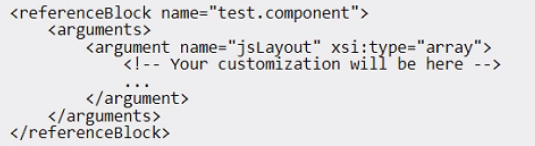
Show Suggested Answer Hide Answer
Suggested Answer: A

To customize a JavaScript component that is written as a function, the developer can use option A. This option will use the prototype property of the function to extend its functionality and add new methods or properties. For example:

function Component() { // Component logic }

Component.prototype.customMethod = function() { // Custom method logic };

This will create a new method called customMethod on the prototype of the Component function, which can be accessed by any instance of the Component object. The developer can also override existing methods or properties on the prototype by reassigning them with new values.

Option B is not correct because it will not extend the native JavaScript function, but create a new function that wraps the original function. This will not allow the developer to access or modify the properties or methods of the original function. Option C is not correct because it will not extend the native JavaScript function, but create a new object that inherits from the original function. This will not allow the developer to customize the original function itself, but only its instances.


Contribute your Thoughts:

0/2000 characters
Ryan
3 months ago
I disagree, I feel like C could be a contender here.
upvoted 0 times
...
Georgeanna
3 months ago
Wait, is it really that straightforward?
upvoted 0 times
...
Tesha
4 months ago
Definitely A, no doubt about it!
upvoted 0 times
...
Xuan
4 months ago
I think Option B might actually work too.
upvoted 0 times
...
Maybelle
4 months ago
Option A is the correct one for initializing JS components.
upvoted 0 times
...
Kimberlie
4 months ago
I feel like option C is the one that sets the component correctly, but I need to double-check my notes on that.
upvoted 0 times
...
Krystina
4 months ago
I’m a bit confused; I thought we could use any of these options, but I can't recall the exact differences between them.
upvoted 0 times
...
Antonette
5 months ago
I remember practicing a similar question about initializing JS components, and I think it was option B that had the right syntax.
upvoted 0 times
...
Tyisha
5 months ago
I think we need to use the `initialize` method in the Layout XML, but I'm not entirely sure which option corresponds to that.
upvoted 0 times
...
Melissa
5 months ago
This is a tricky one, but I think I've got a good strategy. I'll carefully analyze each option, considering how the JS component would be initialized in each case, and then select the most appropriate choice.
upvoted 0 times
...
Ozell
5 months ago
I've seen the `data-mage-init` approach used before, so I think Option B is the way to go. I'll make sure to review the syntax carefully, but I feel pretty confident about this one.
upvoted 0 times
...
Merrilee
5 months ago
Option B seems like the most likely choice, as it includes the `data-mage-init` attribute which is commonly used to initialize JS components. I'll double-check the other options, but I'm leaning towards B.
upvoted 0 times
...
Jacqueline
5 months ago
Hmm, I'm a bit confused by the different options. I'll need to make sure I understand the differences between them before selecting an answer.
upvoted 0 times
...
Mayra
5 months ago
This looks like a tricky one. I'll need to carefully review the Layout XML instructions to determine which one would be used to initialize the JS component.
upvoted 0 times
...
Gayla
10 months ago
You know, if this was a test on dad jokes, I'd totally pick Option C. 'Cause that's the real way to 'layout' the JavaScript component, am I right?
upvoted 0 times
Chaya
9 months ago
I agree, dad jokes are the best! But for this case, I think Option A is the correct instruction to initialize the JS component.
upvoted 0 times
...
Casandra
9 months ago
Dad jokes are always a good choice! Personally, I think Option C is the way to go to initialize the JS component.
upvoted 0 times
...
Chandra
9 months ago
I see what you did there! Option C does sound like a dad joke, but I believe Option B is the right choice for this scenario.
upvoted 0 times
...
Rossana
10 months ago
Haha, that's a good one! But I think Option A is the correct way to initialize the JS component.
upvoted 0 times
...
...
Willard
11 months ago
As an Adobe Commerce developer, I can say with confidence that Option B is the correct answer. Initializing components through Layout XML is a well-established practice.
upvoted 0 times
...
Sharika
11 months ago
Haha, I bet the exam writers are trying to trick us with these options. Option B is definitely the way to go, unless they're feeling extra devious today.
upvoted 0 times
Dustin
10 months ago
I think so too, let's go with Option B.
upvoted 0 times
...
Lura
10 months ago
I agree, Option B seems like the safest choice.
upvoted 0 times
...
...
Layla
11 months ago
I'm not sure, but Option C seems more like it's using the component in a template rather than initializing it. Option B feels like the right choice here.
upvoted 0 times
...
Scarlet
11 months ago
Why do you think Option C is correct?
upvoted 0 times
...
Sabrina
11 months ago
Option B looks like the correct way to initialize the JS component via Layout XML. The `